


- Community
- Topics
Turn on suggestions
Auto-suggest helps you quickly narrow down your search results by suggesting possible matches as you type.
Showing results for
- Community
- :
- Discussions
- :
- Taxes
- :
- State tax filing
- :
- Re: IL Tax Filing
Announcements


- Mark as New
- Bookmark
- Subscribe
- Subscribe to RSS Feed
- Permalink
- Report Inappropriate Content
IL Tax Filing
I sold some property that I inherited from my Dad in IL, but I live in TX. Do I have to file an IL tax return and claim that on an IL tax return.
Topics:
posted
March 12, 2024
3:29 PM
last updated
March 12, 2024
3:29 PM
Connect with an expert

Do you have an Intuit account?
You'll need to sign in or create an account to connect with an expert.
5 Replies


- Mark as New
- Bookmark
- Subscribe
- Subscribe to RSS Feed
- Permalink
- Report Inappropriate Content
IL Tax Filing
Yes, because the land is in Illinois (IL). The good news is that you are allowed to have a cost basis that is the fair market value (FMV) on the date of death of your father. This is usually much higher than what he paid for it. Depending on the selling price there may be little to no gain. Also the time from your father's death to the date of sale will be a factor in helping to arrive at the FMV unless you already have the stepped up basis amount.
The selling price is also the determining factor for filing the IL return. It may not have any tax liability once your cost and selling expenses are used to offset the selling price.
You can enter the sale of your inherited land using the information below, When you get to the IL return be sure nonresident is selected and watch the screens to make the necessary adjustments.
- Under Wages & Income scroll to Investments & Savings
- Select Start/Revisit beside Stocks, Cryptocurrency, Mutual Funds, Bonds, Other (1099-B)
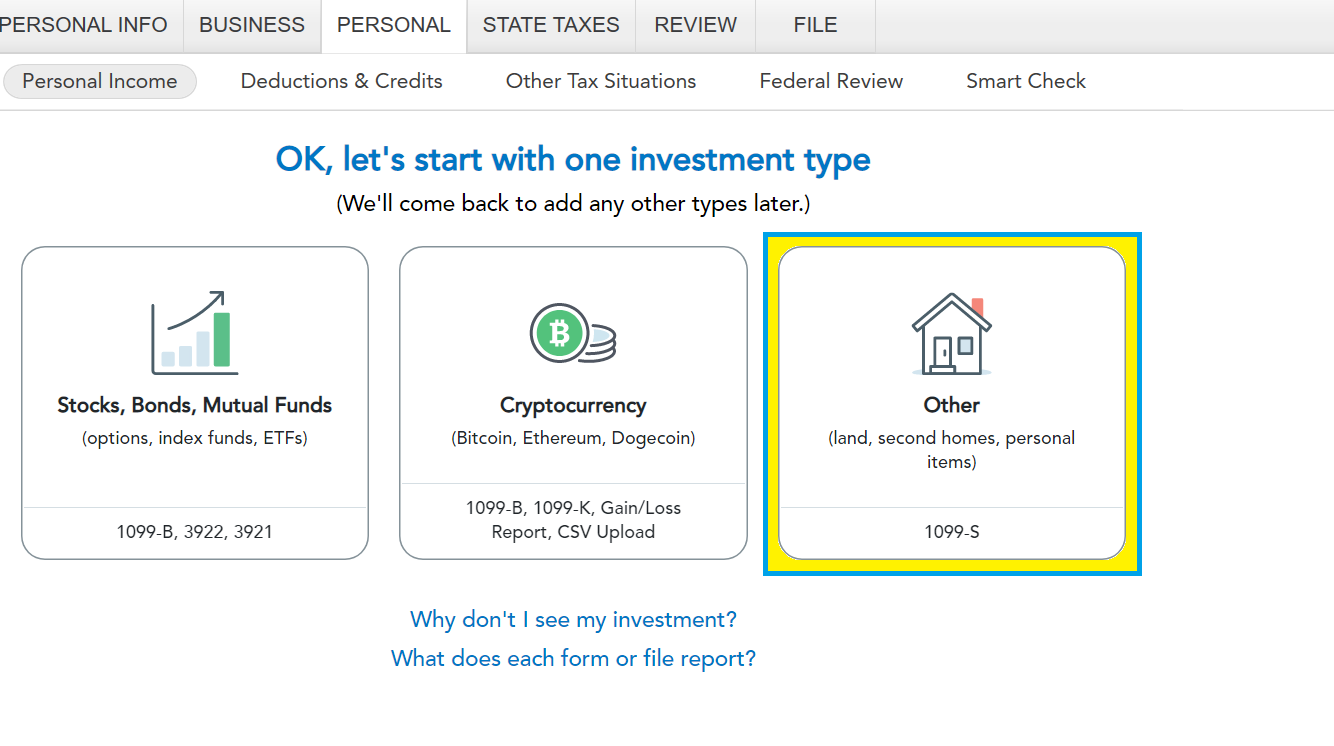
- Select Add Investments or continue to go through the screens to select 'Other' > Continue
- Begin to enter the sale description > Under Type select Other > Under How did you receive select 'I Inherited it' (if applicable)
- For TurboTax Desktop you would enter the description 'Inherited Property' and select 'Long Term' as the hold period
- Enter your sale date and 'Various' as the Acquired date
- Continue to complete the screens until you arrive back at the Wages & Income main page.
Inherited property is always considered to have a long term holding period which provides favored tax treatment.
**Say "Thanks" by clicking the thumb icon in a post
**Mark the post that answers your question by clicking on "Mark as Best Answer"
**Mark the post that answers your question by clicking on "Mark as Best Answer"
March 12, 2024
3:55 PM
- Mark as New
- Bookmark
- Subscribe
- Subscribe to RSS Feed
- Permalink
- Report Inappropriate Content
IL Tax Filing
He put it in our names before he passed, so I don't believe we get the stepped up basis do we?
March 12, 2024
5:23 PM

- Mark as New
- Bookmark
- Subscribe
- Subscribe to RSS Feed
- Permalink
- Report Inappropriate Content
IL Tax Filing
It depends on how it was retitled. If he just gifted you the whole property out right before his date of death then there would be no step up basis. If he added your names to the title and his was still there as well, then you inherited his portion at death, so there will be some step up basis there. Finally, if the title went to a grantor (revocable) trust and then you inherited, there will be step up basis.
**Say "Thanks" by clicking the thumb icon in a post
**Mark the post that answers your question by clicking on "Mark as Best Answer"
**Mark the post that answers your question by clicking on "Mark as Best Answer"
March 13, 2024
8:14 AM
- Mark as New
- Bookmark
- Subscribe
- Subscribe to RSS Feed
- Permalink
- Report Inappropriate Content
IL Tax Filing
He just titled it to my brothers and me. Do we get his cost basis? Or do we have no basis(there was no trust or anything like that)
March 13, 2024
9:23 AM

- Mark as New
- Bookmark
- Subscribe
- Subscribe to RSS Feed
- Permalink
- Report Inappropriate Content
IL Tax Filing
Your basis will depend upon how the title transferred to you and your siblings under Illinois state law.
If the property was gifted to you and your siblings, the basis may become more complicated. IRS Publication 551 Basis of Assets, page 9, states:
Property Received as a Gift
To figure the basis of property you receive as a gift, you must know its adjusted basis to the donor (likely the father's cost) just before it was given to you, its fair market value (FMV) at the time it was given to you, and any gift tax paid on it.
FMV Less Than Donor's Adjusted Basis
If the fair market value (FMV) of the property at the time of the gift is less than the donor's adjusted basis, your basis depends on whether you have a gain or a loss when you dispose of the property.
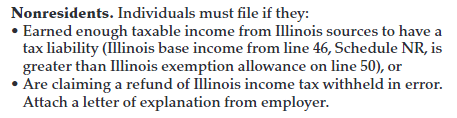
An Illinois nonresident state income tax return may need to be filed because the land was Illinois sourced. The Illinois nonresident filing requirements are here per The TaxBook, page IL-1.
**Say "Thanks" by clicking the thumb icon in a post
**Mark the post that answers your question by clicking on "Mark as Best Answer"
**Mark the post that answers your question by clicking on "Mark as Best Answer"
March 13, 2024
1:07 PM
Still have questions?
Questions are answered within a few hours on average.
Post a Question*Must create login to post


Unlock tailored help options in your account.


Get more help
Ask questions and learn more about your taxes and finances.
Related Content

MattPeck
New Member
Ihavefaith18
New Member

ModestMouse
New Member

kellygunter32
New Member
cindiawi
New Member