
turbotax icon
cancel
Showing results for 
Search instead for 
Did you mean: 
Announcements
Close icon
Do you have a TurboTax Online account?

We'll help you get started or pick up where you left off.

Tax for Back Door Roth Contribution

Hello all,


I am planning to do after tax contribution to traditional IRA and immediately transfer those contributions to Roth IRA for both of us. But my tax is going up when I specify that. What should I do?


Thanks in advance.
1Untitled.jpg

x
Do you have an Intuit account?

Do you have an Intuit account?

You'll need to sign in or create an account to connect with an expert.

2 Best answer

Accepted Solutions
MaryK4
Employee Tax Expert
Intuit Approved! This answer has been verified for accuracy by an Intuit expert employee

Tax for Back Door Roth Contribution

If you have not done the step to indicate the traditional IRA contributions were nondeductible, TurboTax is treating it as a taxable event.  Go to How do I enter a backdoor Roth IRA conversion? and enter the traditional IRA contributions so the 8606 is created and your tax will be re-calculated.  

**Say "Thanks" by clicking the thumb icon in a post
**Mark the post that answers your question by clicking on "Mark as Best Answer"

View solution in original post

AnnetteB6
Employee Tax Expert

Tax for Back Door Roth Contribution

Yes, you should clear the information that you entered about recharacterization.  This is not the same thing as a conversion.  It is taking a Traditional IRA contribution and changing it into a Roth IRA contribution, or vice versa.  


So, if your intention (as stated in your original question) is to make the backdoor contribution to your Roth IRA by converting a non-deductible Traditional IRA to the Roth IRA, then you do need to clear the information about the recharacterization.  


Yes, if you make the 2026 non-deductible Traditional IRA contribution in 2026 and immediately convert it to a Roth IRA, then your Form 1099-R will show the amounts that were contributed for 2025 and 2026 as a distribution.  Then, on your 2026 tax return, you will enter the 2026 non-deductible Traditional IRA contribution and the basis will include both the 2025 and 2026 amounts.  This will make the conversion to the Roth IRA non-taxable (unless there are some minimal earnings added to the account between the contribution and the distribution).


To learn more, take a look at the following TurboTax help article:


What are IRA conversions and recharacterizations?


@tnanaihsoj 
 

**Say "Thanks" by clicking the thumb icon in a post
**Mark the post that answers your question by clicking on "Mark as Best Answer"

View solution in original post

5 Replies
MaryK4
Employee Tax Expert
Intuit Approved! This answer has been verified for accuracy by an Intuit expert employee

Tax for Back Door Roth Contribution

If you have not done the step to indicate the traditional IRA contributions were nondeductible, TurboTax is treating it as a taxable event.  Go to How do I enter a backdoor Roth IRA conversion? and enter the traditional IRA contributions so the 8606 is created and your tax will be re-calculated.  

**Say "Thanks" by clicking the thumb icon in a post
**Mark the post that answers your question by clicking on "Mark as Best Answer"

Tax for Back Door Roth Contribution

Thank you very much for quick reply and link to the article.


Now I have a different issue. Since I haven't yet contributed to traditional IRA and transferred to Roth, I don't have 1099-R forms.

Any idea how I can navigate through this?


TIA

AnnetteB6
Employee Tax Expert

Tax for Back Door Roth Contribution

Yes, you need to report the non-deductible Traditional IRA contributions on your 2025 tax return, if you intend the contribution to be for the 2025 tax year.  Doing so will report the basis of the Traditional IRA on Form 8606.


Then, when you convert the Traditional IRA to the Roth IRA, it will actually be done in 2026.  Therefore, you will receive a Form 1099-R for 2026 in early 2027 that is reporting the Traditional IRA distribution.  When that Form 1099-R is entered into your 2026 tax return, it should not be taxable since the basis was reported on your 2025 Form 8606.  Conversions can be done at any time and are only associated with the year in which it is done, unlike IRA contributions which are tied to a particular tax year.


Or, if you intend for the Traditional IRA contributions to be made for the 2026 tax year, then nothing is reported on your 2025 tax return.


@tnanaihsoj 

**Say "Thanks" by clicking the thumb icon in a post
**Mark the post that answers your question by clicking on "Mark as Best Answer"

Tax for Back Door Roth Contribution

Thanks @AnnetteB6 


"Conversions can be done at any time and are only associated with the year in which it is done, unlike IRA contributions which are tied to a particular tax year."

- I did not know this.

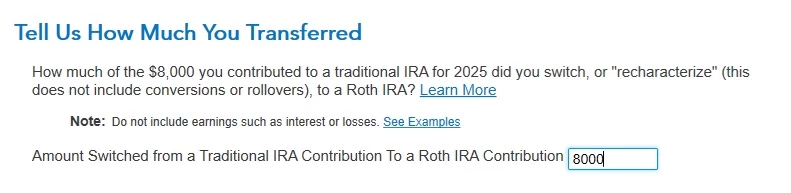
So I should clear below shown form about recharacterization? Now let's say I contribute to traditional IRA for 2026 in 2026 and then transfer immediately to Roth. Then 1099-R form for 2026 will have two years worth of contribution?

Thank you

image.png


AnnetteB6
Employee Tax Expert

Tax for Back Door Roth Contribution

Yes, you should clear the information that you entered about recharacterization.  This is not the same thing as a conversion.  It is taking a Traditional IRA contribution and changing it into a Roth IRA contribution, or vice versa.  


So, if your intention (as stated in your original question) is to make the backdoor contribution to your Roth IRA by converting a non-deductible Traditional IRA to the Roth IRA, then you do need to clear the information about the recharacterization.  


Yes, if you make the 2026 non-deductible Traditional IRA contribution in 2026 and immediately convert it to a Roth IRA, then your Form 1099-R will show the amounts that were contributed for 2025 and 2026 as a distribution.  Then, on your 2026 tax return, you will enter the 2026 non-deductible Traditional IRA contribution and the basis will include both the 2025 and 2026 amounts.  This will make the conversion to the Roth IRA non-taxable (unless there are some minimal earnings added to the account between the contribution and the distribution).


To learn more, take a look at the following TurboTax help article:


What are IRA conversions and recharacterizations?


@tnanaihsoj 
 

**Say "Thanks" by clicking the thumb icon in a post
**Mark the post that answers your question by clicking on "Mark as Best Answer"

Unlock tailored help options in your account.

message box icon

Get more help

Ask questions and learn more about your taxes and finances.

Post your Question




