Level 4
Feb 8, 2026 4:07 PM UTC
Question

Income Taxes Withheld and Sales Expenses for Inherited House in Foreign Country

I sold an inherited house in a foreign country that was unoccupied for 1 1/2 years between the parent's death and sale.  I got an appraisal done to get the FMV on deceased's date of death.  This came at around $150K (just to use round numbers as an example).  I paid all utility bills and house taxes for the 1 1/2 year period.  I spent money traveling to the foreign country and I sold the house for a selling price of $50K at a significant loss just to get rid of it.  However, I only received $35K at sale, $15K worth of foreign income taxes in that country were deducted at source.  I have entered the following so far in the Investment Income EasyStep:
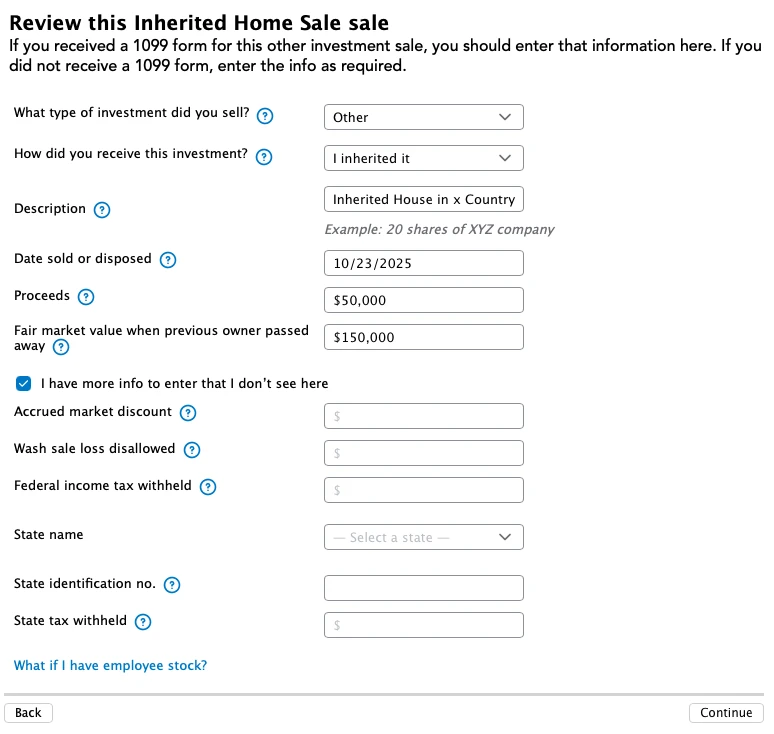
I have the following questions:

  1. For proceeds, should I enter $50K (selling price) or $35K (actual amount received)?  If I enter $50K, how do I claim credit for the $15K in foreign income taxes paid (if this is even possible in my situation)?
  2. Where can I find what sales expenses are deductible? I found IRS publications explaining deductible sales expenses for your own house and rental property but less clear to me what is deductible for inherited property.  Any links appreciated.  More specifically, which of the following are deductible: travel (tickets, lodging, boarding, local transportation), utilities for the 1 1/2 years, house taxes, appraisal to get FMV?

Thank you so much in advance for your help!  I have received awesome answers here, I'm sure you'll help me get through this as well.

    27 replies

    DaveF1006
    Alumni - Intuit
    Feb 9, 2026 7:07 PM UTC

    For the taxes paid to other countries, you would need to fill out the Foreign Tax Credit section of the return. This section is different from the investment section where you reported the sale. I will list the steps at the bottom of this response.


    For the first question, you will enter $50K for the amount of proceeds. As I mentioned, a foreign tax credit will be applied when you complete the foreign tax section on your return. 


    When you sell an inherited house, the tax rules combine aspects of both investment property and capital asset guidelines are the same, no matter where the house is. The key to your question is distinguishing between Expenses of Sale and Holding Costs. 


    For example, your appraisal for FMV purposes, improvements, and selling costs are added to the basis of your house to reduce its capital gains. Any travel expenses, utilities, house taxes, lodging, boarding, and local transportation aren't. 


    You are eligible for a foreign tax credit or an itemized deduction for the taxes paid.  Here is how to report in TurboTax.


    1. Go to Federal
    2. Go to Deductions & Credits.
    3. Scroll down to Estimates and Other Taxes Paid.
    4. Click Start/Revisit next to Foreign Taxes.
    5. Begin filling out the section. When it asks you for the type of income, indicate it is passive income.

    Here are some links that will prove helpful to you.


    IRS Publication 551: See the section "Property Acquired from a Decedent."

    IRS Publication 550: See "Capital Gains and Losses" for how to report the sale.

    IRS Publication 523: While this is for primary homes, the "Selling Expenses" list on page 12 is a great checklist for what you can subtract from your sale price.


    As I mentioned before, the reporting rules are the same no matter where the property is located. even on foreign soil. Aslo uncheck the box that says you have more information to report. You have no more information to report in the remainder of that section other than the information you have already recorded.


    **Say "Thanks" by clicking the thumb icon in a post. **Mark the post that answers your question by clicking on "Mark as Best Answer"
    Level 4
    Feb 10, 2026 8:09 PM UTC

    I have three different types of foreign taxes I paid last year.  The ones reported on 1099-DIV ($1,000), ones reported on a foreign equivalent of 1099-INT ($500), and then the foreign taxes withheld on sale of the money losing inherited property ($15,000) (I have a 1099-S equivalent documentation from the foreign country for this sale.)  


    First:

    Please confirm this is all PASSIVE CATEGORY INCOME.  I don't see how the inherited house sale is GENERAL CATEGORY INCOME based on 1116 instructions.


    Second:

    When answering interview questions regarding the foreign tax credit, the 1099-DIV and pretend 1099-INT info carries over into 1116 automatically.  However, for the sale of the house, which I have already reported on 8949, the capital loss information obviously does NOT carry into 1116.  I can add $15,000 under passive income category for that country as other foreign taxes paid.  However, my question is this: do I need to add the capital loss information of $100,000 from 8949 for inherited house sale manually into the following 1116 interview question (see below)?  This results in a complete inability to claim any foreign tax credit this year, with a carry over into 10 years which I will not even use a fraction of as I am closing the bank account in the foreign country (done there) and my 1099-DIV foreign taxes are small year to year.  I know I have the option of deduction vs. credit, but first I need to know the answer to my question so I am thinking about this correctly.

     
    DaveF1006
    Alumni - Intuit
    Feb 10, 2026 11:48 PM UTC

    Yes, this is all considered Passive Category Income. Also,  you must include that $100,000 of foreign loss in your Form 1116 calculation, even if it means you can't use the credit this year. 


    Your Foreign Tax Credit is limited by a ratio.  That ratio is (Foreign Taxable Income) /(Worldwide taxable income) X US Tax Liability.  The problem is if you have $1500 of passive income from dividends but a $100,000 capital loss from the house in the same category, your net foreign source income for that category becomes zero (or negative). When the numerator of that fraction is zero, your allowable credit for the year is zero.


    You can claim the foreign taxes as an itemized deduction on your return, as this may add some relief to your tax situation. This depends on whether your itemized deductions are more than your standard deduction for the year. If they are not, it may not make a difference.


    @JackSpaniel 


    **Say "Thanks" by clicking the thumb icon in a post. **Mark the post that answers your question by clicking on "Mark as Best Answer"